I have worn contact lenses for 16 years. (A little over half of my life!) I have always worn hard gas permeable lenses. I have had such good luck with this type of contact that in all that time I have only had three pair. The first pair I wore from the time I was 14 until I was 22. One drunken night when I was 22, I finally scratched one beyond repair and had to get new ones. The second pair I wore from the time I was 22 until last year. Last fall I decided I needed a new pair because my eyesight had changed enough that I was no longer seeing well. So, last November I went to my first German eye doctor and got a new pair of glasses and a new pair of contacts.
I was afraid that the contact lens people would try to convert me to disposable soft lenses, which I had absolutely no desire to try. Therefore, when I got fitted for my contacts I told them that I wanted to stick with gas permeable lenses because I had had such good luck with them in the past. They agreed with me. In fact, they told me that if you have always worn hard lenses it is better to stick with them.
With my hard lenses, I have also always used one type of care system (X) and have always had very good luck with it. At first I was worried that they wouldn't carry it in here Germany, but I had good fortune and didn't have any problem finding it. My lenses were comfortable, I could see very clearly, and my eyes didn't dry out. However, when I got my new lenses here in Germany the people told me that care system X was evil.
So, in addition to these new lenses, they gave me a different care system (Z). Since we have private insurance, my insurance not only paid for most of my lens costs, but when I got a prescription for the care system, they paid for it too. The eye doctor gave me a prescription and I got a year's supply (12 bottles) of care system Z.
For about 6 months I went about my business with my new contacts and discovered two things about care system Z: First, even though I had supposedly received a year's supply of it, it was obvious it wouldn't last for the entire year. Second, I noticed that with care system Z my eyes were dry and irritated much more frequently than they had ever been.
After considering the situation, I decided that I should go back to care system X. Sure the contact lens people had told me it was evil, but it was made by a different company than care system Z. Since they gave me no explanation of why care system X was evil, I figured this meant that care system X was evil because it was made by company X and that the contact lens people had a deal with company Z for care system Z. I decided that since I had never had any problems with care system X in the past I would just continue to use it. So about two or three months ago, I bought some of care system X and had been using it part of the time. When I used it I noticed my eyes weren't so dry anymore and wearing my lenses was comfortable again.
Then a couple of weeks ago I noticed that my left lens seemed foggy. At first I thought I hadn't cleaned it very well, so I enzymed it and it seemed a little better. However, the fog came back. At this point I ran out of care system X, so I used care system Z again and things improved, except my eyes were constantly red and dry.
Today I went over to my local Optiker (which is not the same as the eye doctor and not the place where I got my contacts) and found out what the problem was. Unbeknownst to me, there are actually two types of gas permeable lenses: those with some sort of coating and those without. In the US, the ones without the coating are the most common and care system X is highly recommended for them. In Germany, however, the most common lenses are the ones with coating and care system X is not recommended for them. (Yes, it is evil!) Coincidentally, my new contacts were the kind with coating. By using care system X with my new lenses, I had, in effect, removed the coating. Without the coating, the lenses were not only irritating my eyes and drying them out, but were more or less ruined. Luckily, since I hadn't been using care system X on them for too long, some of the coating is still there, but now I am afraid that if I wear them they may scratch my cornea or cause some other damage.
Hard gas permeable contact lenses are not cheap and my insurance only pays for a new pair every two or three years, so not only do I need to get a new pair of contacts or wear my glasses (oh the horror!), I have to pay for them myself.
Boy, do I need that job right about now!
13 October 2004
12 October 2004
Welcome Back!
Oh, this has been a day!
First I stayed up WAY too late last night... especially since I had a job interview today.
After I got home, I went to publish an account of my adventures on my blog and what do you know?! The free blog host I had been using since March decided with no warning to start charging! Since I am a cheap skate, I refuse to do this.
What really pissed me off was that I couldn't even get to my archives. HA HA on them though! I just so happened to back up my archives only two days ago! However, I have spent all afternoon uploading my archives back to my old blogger spot. So, here I am back, but all new and improved!
Stay tuned for design modifications! :)
First I stayed up WAY too late last night... especially since I had a job interview today.
(Note to self: You are too old to stay up until 2 a.m. reading a book and then getting up at 7 a.m. in order to get ready for a job interview.)Anyway, I think that the interview went pretty well. But then I had to wrestle with the joys of public transportation.
After I got home, I went to publish an account of my adventures on my blog and what do you know?! The free blog host I had been using since March decided with no warning to start charging! Since I am a cheap skate, I refuse to do this.
What really pissed me off was that I couldn't even get to my archives. HA HA on them though! I just so happened to back up my archives only two days ago! However, I have spent all afternoon uploading my archives back to my old blogger spot. So, here I am back, but all new and improved!
Stay tuned for design modifications! :)
09 October 2004
A Day in Dresden
And now for the final installment in my "Adventures in Eastern Germany" series...
Ever since we moved to Germany, one of the cities that I have wanted to see was Dresden.
The reason that I wanted to visit Dresden is because of Anne Rice. One reason that she is my favorite author is because I love her descriptions of cities. I am convinced that New Orleans, Paris, and San Francisco are my favorite cities as a direct result of her writings.
Anyway, in Anne Rice's Vampire Chronicles, one of my favorite characters, Marius, spends some time in Dresden during the 17th century in search of his long lost love, Pandora. Strangely enough, Rice doesn't describe Dresden in the intricate way that she does Paris, New Orleans, and San Francisco, but it still made enough of an impression on me that I wanted to go there.
Finally, on October 3, the day of "Deutsche Einheit" we made it there. It was a perfect fall day: it was warm, the sun was shining, and the sky was blue with just a few clouds. In addition to my desire to see Dresden for "Anne Rice" reasons, I also wanted to see its world famous opera house, the Semperoper. So that is where our tour of Dresden began. Unfortunately, by the time we got there, the opera house tours were over for the day and we didn't get to see the inside. However, the outside is gorgeous, and in my opinion, rivals the Opera House in Paris. We then wandered over to the square where the Frauenkirche is being rebuilt.
Actually, there is quite a bit of reconstruction going on in Dresden. For those of you not familiar with it, let me give a two sentence modern day history of Dresden: In February of 1945, the Allies bombed Dresden. The bombing was so intense that not only did it flatten Dresden, but a huge fire gutted the city.
A. gave me this quick history lesson on our way to Dresden, and then I learned more after seeing an exhibit showing pictures and other artifacts of the city in the aftermath of the bombing campaign and fire. The destruction was complete and even over fifty years later the sights were still very moving. Along with the photos were excerpts of diary entries of those days and other objects. One thing that caught my attention were the "Lebenszeichen." After the fire, the Allies allowed the survivors to fill out "Lebenszeichen" (life signs) so that relatives would know that they had survived. However, they were only allowed ten words, apparently so that no code messages could be sent. One that was on display simply stated, "Wir haben erlebt. Der Stadt ist weg." (We survived. The city is gone.)
Apparently, during the time of the DDR, very little was reconstructed in Dresden (or in all of eastern Germany for that matter). I asked A. if this was because they didn't have the money, or if it was because it wasn't deemed an important task, or if it was simply left as a reminder of the past. He stated he simply didn't know. For whatever reason East Germany hadn't been rebuilt, once Germany was reunited, lots of money went to former East Germany to help them reconstruct and modernize. While I didn't see much evidence of this in Chemnitz, in Dresden one way the money is being used is to renovate landmarks such as the Semperoper, the Frauenkirche, the Residenzschloß, and the Zwinger.
From what I understand, in comparison to most places in the former DDR, Dresden is a bustling city and a moderate economic success story. I found it livelier and far more attractive than Chemnitz and would visit it again in the future.
* * * * *
See more photos from my trip in my photo gallery!
Ever since we moved to Germany, one of the cities that I have wanted to see was Dresden.
The reason that I wanted to visit Dresden is because of Anne Rice. One reason that she is my favorite author is because I love her descriptions of cities. I am convinced that New Orleans, Paris, and San Francisco are my favorite cities as a direct result of her writings.
Anyway, in Anne Rice's Vampire Chronicles, one of my favorite characters, Marius, spends some time in Dresden during the 17th century in search of his long lost love, Pandora. Strangely enough, Rice doesn't describe Dresden in the intricate way that she does Paris, New Orleans, and San Francisco, but it still made enough of an impression on me that I wanted to go there.
Finally, on October 3, the day of "Deutsche Einheit" we made it there. It was a perfect fall day: it was warm, the sun was shining, and the sky was blue with just a few clouds. In addition to my desire to see Dresden for "Anne Rice" reasons, I also wanted to see its world famous opera house, the Semperoper. So that is where our tour of Dresden began. Unfortunately, by the time we got there, the opera house tours were over for the day and we didn't get to see the inside. However, the outside is gorgeous, and in my opinion, rivals the Opera House in Paris. We then wandered over to the square where the Frauenkirche is being rebuilt.
Actually, there is quite a bit of reconstruction going on in Dresden. For those of you not familiar with it, let me give a two sentence modern day history of Dresden: In February of 1945, the Allies bombed Dresden. The bombing was so intense that not only did it flatten Dresden, but a huge fire gutted the city.
A. gave me this quick history lesson on our way to Dresden, and then I learned more after seeing an exhibit showing pictures and other artifacts of the city in the aftermath of the bombing campaign and fire. The destruction was complete and even over fifty years later the sights were still very moving. Along with the photos were excerpts of diary entries of those days and other objects. One thing that caught my attention were the "Lebenszeichen." After the fire, the Allies allowed the survivors to fill out "Lebenszeichen" (life signs) so that relatives would know that they had survived. However, they were only allowed ten words, apparently so that no code messages could be sent. One that was on display simply stated, "Wir haben erlebt. Der Stadt ist weg." (We survived. The city is gone.)
Apparently, during the time of the DDR, very little was reconstructed in Dresden (or in all of eastern Germany for that matter). I asked A. if this was because they didn't have the money, or if it was because it wasn't deemed an important task, or if it was simply left as a reminder of the past. He stated he simply didn't know. For whatever reason East Germany hadn't been rebuilt, once Germany was reunited, lots of money went to former East Germany to help them reconstruct and modernize. While I didn't see much evidence of this in Chemnitz, in Dresden one way the money is being used is to renovate landmarks such as the Semperoper, the Frauenkirche, the Residenzschloß, and the Zwinger.
photo by blondelibrarian
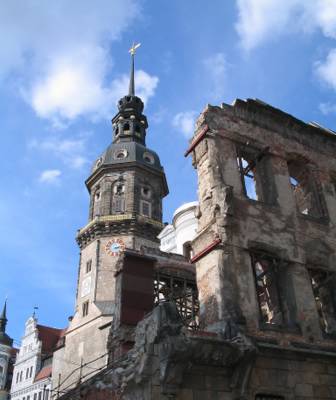
This photo shows "Das Residenzschloß". The part of the building that houses the tower has been rebuilt and is open to the public. However, the south side is still being renovated.
From what I understand, in comparison to most places in the former DDR, Dresden is a bustling city and a moderate economic success story. I found it livelier and far more attractive than Chemnitz and would visit it again in the future.
* * * * *
See more photos from my trip in my photo gallery!
08 October 2004
A Mining Experience
When I go on vacation I like to visit cities and experience architecture, art, and other touristy-type things. I love to see the places that I have read about and I get a kick out of standing in the same spot some famous person did years ago. For example, when I visited Versailles I thought to myself, "Wow! This is so cool! I am standing somewhere where Louis XIV himself once stood!"
However, I am also game to do unusual things and since I met A. I have done some things that I probably never would have done except that he wanted to do them so I said, "Sure! Why not?!" We spent our honeymoon in Arizona and while we saw normal things like the Grand Canyon and the Petrified Forest, we also visited Kitt Peak, a major astronomical observatory outside of Tucson. So, when A. excitedly informed me that one of things that was planned when we visited eastern Germany last week was a mining tour, I gladly went along.
Between Chemnitz and Dreden lies the small town of Freiberg (not to be confused with Freiburg in southwestern Germany). Since medieval times Freiberg has been home to one of the world's oldest continuously used silver mines. Today the mine is used for mining education and tours and this is where we spent two and a half hours approximately 250 meters underground last Saturday.
I knew this would be an interesting tour when the first thing we were required to do was dress up as miners. The tour guide informed us that this was necessary because we needed to protect our clothing as we would be crawling for part of the tour. Rubber boots were mandatory as the mine was wet and since my feet are small, I had some trouble finding a pair to fit me. Once the nice tour guide got me some boots from the children's dressing room, I was set to go. After we were supplied with a lamp and a hardhat we took a small elevator down, down, down into the dark.
After a quick overview of the process of mining, we boarded railway cars and were taken even deeper into the mine. The tour guide then took us through some relatively flat and open areas of the mine where he pointed out the ore channels in the walls; all the while telling us more mining history and stories. Eventually we stopped in front of a rickety-looking ladder and after relating some more history of the Freiberg mine, we were informed that it was now time to climb!
There were a few women in our group and before we climbed, the tour guide informed us this was no place to be pussy-footing around and worrying about getting dirty. As I started up the ladder, I fully agreed; it was a long way down and I was holding on to the muddy ladder for all I was worth!
As we climbed, the tunnel got narrower and shorter, and indeed, we had to crawl. Even so, I kept bumping my head on the rock ceiling and was ever so thankful for my hardhat. Finally, we came to a small recess that I thought was a dead end.
It turned out it wasn't; there was a minute passageway that we had to navigate. Eventually, we came to another alcove and instead of choosing the simple way through, the group decided to climb again.
Before starting this final stage, the tour guide told us that at the top of the ladder there were three routes; we were not to take the right one, I didn't catch much about the middle one, but I was pretty sure he told us to take the left one. I had been behind A. this whole time, but when I was to the top of the ladder he was out of my sight. I caught a glimpse of him going down one way, so I went that way too, not paying attention to which passageway I had chosen.
I was just beginning to hear the rest of the group behind me, when suddenly A. called out that he couldn't see anyone anymore. I said, "Did you go left?" He replied that he wasn't sure. I told him to yell out, which he did. After a second, the part of the group that was ahead of him called out that he was going the right way and to keep on coming; we were almost to the end.
After I got out of the tunnel that was no more than 18 inches wide by 5 foot tall, I realized my heart was racing, that I was having trouble catching my breath, and that I felt light headed. I thought at the time maybe I had had a claustrophobic episode, but now I am pretty sure I had a mild panic attack. The thought that we could have gotten lost in that mine really frightened me.
After climbing down one final ladder, walking past some stalagmites and stalactites, rinsing off our boots and hands, and a ride in the elevator back up, up, up into the light, the tour was over. With the exception of the little panic attack at the thought of being lost, I really enjoyed the experience and I would definitely do it again!
* * * * *
Currently playing: "Welcome Home (Sanitarium)" by Metallica
However, I am also game to do unusual things and since I met A. I have done some things that I probably never would have done except that he wanted to do them so I said, "Sure! Why not?!" We spent our honeymoon in Arizona and while we saw normal things like the Grand Canyon and the Petrified Forest, we also visited Kitt Peak, a major astronomical observatory outside of Tucson. So, when A. excitedly informed me that one of things that was planned when we visited eastern Germany last week was a mining tour, I gladly went along.
Between Chemnitz and Dreden lies the small town of Freiberg (not to be confused with Freiburg in southwestern Germany). Since medieval times Freiberg has been home to one of the world's oldest continuously used silver mines. Today the mine is used for mining education and tours and this is where we spent two and a half hours approximately 250 meters underground last Saturday.
I knew this would be an interesting tour when the first thing we were required to do was dress up as miners. The tour guide informed us that this was necessary because we needed to protect our clothing as we would be crawling for part of the tour. Rubber boots were mandatory as the mine was wet and since my feet are small, I had some trouble finding a pair to fit me. Once the nice tour guide got me some boots from the children's dressing room, I was set to go. After we were supplied with a lamp and a hardhat we took a small elevator down, down, down into the dark.
After a quick overview of the process of mining, we boarded railway cars and were taken even deeper into the mine. The tour guide then took us through some relatively flat and open areas of the mine where he pointed out the ore channels in the walls; all the while telling us more mining history and stories. Eventually we stopped in front of a rickety-looking ladder and after relating some more history of the Freiberg mine, we were informed that it was now time to climb!
There were a few women in our group and before we climbed, the tour guide informed us this was no place to be pussy-footing around and worrying about getting dirty. As I started up the ladder, I fully agreed; it was a long way down and I was holding on to the muddy ladder for all I was worth!
As we climbed, the tunnel got narrower and shorter, and indeed, we had to crawl. Even so, I kept bumping my head on the rock ceiling and was ever so thankful for my hardhat. Finally, we came to a small recess that I thought was a dead end.
photo by blondelibrarian
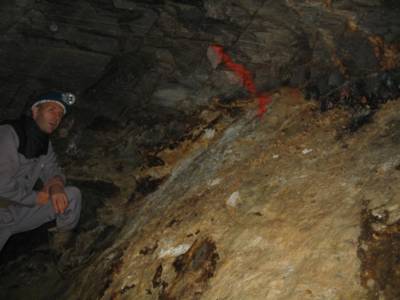
It turned out it wasn't; there was a minute passageway that we had to navigate. Eventually, we came to another alcove and instead of choosing the simple way through, the group decided to climb again.
Before starting this final stage, the tour guide told us that at the top of the ladder there were three routes; we were not to take the right one, I didn't catch much about the middle one, but I was pretty sure he told us to take the left one. I had been behind A. this whole time, but when I was to the top of the ladder he was out of my sight. I caught a glimpse of him going down one way, so I went that way too, not paying attention to which passageway I had chosen.
I was just beginning to hear the rest of the group behind me, when suddenly A. called out that he couldn't see anyone anymore. I said, "Did you go left?" He replied that he wasn't sure. I told him to yell out, which he did. After a second, the part of the group that was ahead of him called out that he was going the right way and to keep on coming; we were almost to the end.
After I got out of the tunnel that was no more than 18 inches wide by 5 foot tall, I realized my heart was racing, that I was having trouble catching my breath, and that I felt light headed. I thought at the time maybe I had had a claustrophobic episode, but now I am pretty sure I had a mild panic attack. The thought that we could have gotten lost in that mine really frightened me.
After climbing down one final ladder, walking past some stalagmites and stalactites, rinsing off our boots and hands, and a ride in the elevator back up, up, up into the light, the tour was over. With the exception of the little panic attack at the thought of being lost, I really enjoyed the experience and I would definitely do it again!
* * * * *
Currently playing: "Welcome Home (Sanitarium)" by Metallica
07 October 2004
Culture in Chemnitz
Since my first impressions of Chemnitz seemed to point to a dull and lifeless city, you can imagine how pleased we were to find that it has a high-quality, all be it small, cultural scene.
Chemnitz has its own opera house and though it is tiny in comparison to the Semperoper which we also saw on this trip, it is charming and cozy. These characteristics make it the perfect place to enjoy an opera or a ballet.
As luck would have it, there was a ballet performed on Friday evening and we had the opportunity to attend it. The ballet we saw was an adaptation of the lighthearted Coppélia. I have always enjoyed the ballet, so this was a special treat for me and even though he is a hard-core scientist, A. fancied it too.
On Tuesday evening, we had the occasion to see the play Acht Frauen at Chemnitz's "Shauspielhaus." (Acht Frauen is the translated title of a French play by Robert Thomas. It was made into a movie in 2002 and you can read the plot here.) We both liked this "who-done-it" comedy and even though sometimes they were talking extremely fast and I had to concentrate to keep up, I understood it relatively well.
According to the information packet that we received, there were other events we could have attended in the coming days, but since we were only there for a few days, we saw what we could.
* * * * *
Coming Soon: A Mining Experience and A Day in Dresden!
Chemnitz has its own opera house and though it is tiny in comparison to the Semperoper which we also saw on this trip, it is charming and cozy. These characteristics make it the perfect place to enjoy an opera or a ballet.
photo by blondelibrarian

As luck would have it, there was a ballet performed on Friday evening and we had the opportunity to attend it. The ballet we saw was an adaptation of the lighthearted Coppélia. I have always enjoyed the ballet, so this was a special treat for me and even though he is a hard-core scientist, A. fancied it too.
On Tuesday evening, we had the occasion to see the play Acht Frauen at Chemnitz's "Shauspielhaus." (Acht Frauen is the translated title of a French play by Robert Thomas. It was made into a movie in 2002 and you can read the plot here.) We both liked this "who-done-it" comedy and even though sometimes they were talking extremely fast and I had to concentrate to keep up, I understood it relatively well.
According to the information packet that we received, there were other events we could have attended in the coming days, but since we were only there for a few days, we saw what we could.
* * * * *
Coming Soon: A Mining Experience and A Day in Dresden!
Murphy's Law
A few weeks ago I had another job interview. I didn't get too excited about it on the blog, because first of all it wasn't a library job and second because with the way that my job hunting has been going here in Germany I didn't really have my hopes up.
So of course they called to ask me in for a second interview while I was on vacation.
Luckily they only called on Tuesday and for good measure sent me an email requesting that I give them a call. To sum it up: Next Tuesday I have a second interview for the position of "team assistant" at a local software firm. The library it ain't, but at least it is something to give me a little bit of spending money.
Maybe I won't have to default on my college loans after all...
So of course they called to ask me in for a second interview while I was on vacation.
Luckily they only called on Tuesday and for good measure sent me an email requesting that I give them a call. To sum it up: Next Tuesday I have a second interview for the position of "team assistant" at a local software firm. The library it ain't, but at least it is something to give me a little bit of spending money.
Maybe I won't have to default on my college loans after all...
06 October 2004
First Impressions of Eastern Germany
We just returned from our trip to eastern Germany. After two and a half years in Germany, this was my first time in eastern Germany and I have to say that it was a very enlightening experience.
The first thing that A. pointed out to me when we crossed the border from Bavaria into Sachsen was an old communist watch tower and a few other left-over relics from the DDR. He then informed me that during those times no villages or houses were allowed to be 5-10 kilometers from the border because there were barbed wire fences and mine fields.
Since coming to Germany I have heard tales about the depression and abandonment of East Germany: I had read that once the Iron Curtain fell, many people fled to the West seeking a better life and those left behind were mostly the poor and uneducated. I had also heard that there are buildings that are still standing where you can see the bullet holes left from the War. My mother-in-law once commented that every time she went to the east she felt that it was just rotting away.
However, it wasn't until we arrived in Chemnitz (which until 1990 was called Karl-Marx-Stadt) that these accounts made a significant impression on me. One of the first things I noticed was that beautiful architecture stood side by side with functional communist design and both were in similar states of decay. Windows weren't just boarded up, they were bricked up and the ones that weren't were covered with graffiti. The buildings that weren't falling apart were usually dirty and the lower floors that might house businesses were either for rent or looked like they were soon to go out of business. Rows and rows of apartment buildings were utterly dark and the streets were silent. Compared to a bustling metropolis like Munich, Chemnitz looked and felt deserted.
Population-wise, Chemnitz is much smaller than Munich, so I expected it to be quieter. However, it wasn't just a bit quieter: in comparison to a western German city of equal size, Chemnitz was DEAD! At 7:00 p.m. on a Friday evening the Fußgangerzone (pedestrian area) was almost completely empty. The streets had very little traffic and we saw very few people out and about. For many of my American readers this may not seem too strange, but for those of you living in Germany you know what I mean.
All of these observations came to me in the first six hours I was in eastern Germany. We were planning on being there for five days, so I wondered how other areas of eastern Germany would compare to my first impressions. Those thoughts later...
The first thing that A. pointed out to me when we crossed the border from Bavaria into Sachsen was an old communist watch tower and a few other left-over relics from the DDR. He then informed me that during those times no villages or houses were allowed to be 5-10 kilometers from the border because there were barbed wire fences and mine fields.
Since coming to Germany I have heard tales about the depression and abandonment of East Germany: I had read that once the Iron Curtain fell, many people fled to the West seeking a better life and those left behind were mostly the poor and uneducated. I had also heard that there are buildings that are still standing where you can see the bullet holes left from the War. My mother-in-law once commented that every time she went to the east she felt that it was just rotting away.
However, it wasn't until we arrived in Chemnitz (which until 1990 was called Karl-Marx-Stadt) that these accounts made a significant impression on me. One of the first things I noticed was that beautiful architecture stood side by side with functional communist design and both were in similar states of decay. Windows weren't just boarded up, they were bricked up and the ones that weren't were covered with graffiti. The buildings that weren't falling apart were usually dirty and the lower floors that might house businesses were either for rent or looked like they were soon to go out of business. Rows and rows of apartment buildings were utterly dark and the streets were silent. Compared to a bustling metropolis like Munich, Chemnitz looked and felt deserted.
Population-wise, Chemnitz is much smaller than Munich, so I expected it to be quieter. However, it wasn't just a bit quieter: in comparison to a western German city of equal size, Chemnitz was DEAD! At 7:00 p.m. on a Friday evening the Fußgangerzone (pedestrian area) was almost completely empty. The streets had very little traffic and we saw very few people out and about. For many of my American readers this may not seem too strange, but for those of you living in Germany you know what I mean.
All of these observations came to me in the first six hours I was in eastern Germany. We were planning on being there for five days, so I wondered how other areas of eastern Germany would compare to my first impressions. Those thoughts later...
Subscribe to:
Posts (Atom)